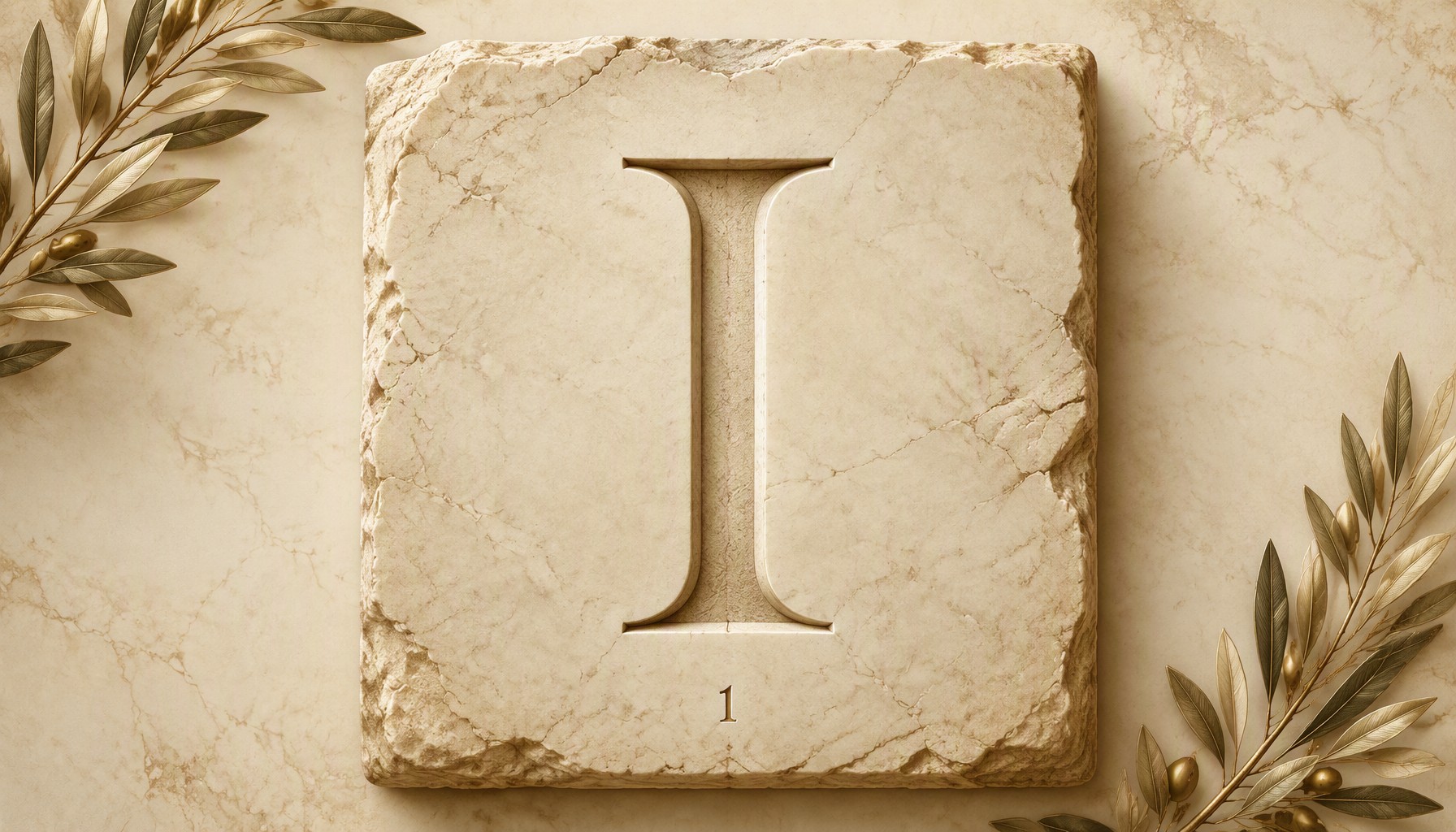
The Roman number I corresponds to the arabic number 1.
There is no common alternative notation for this number.
How I Is Built
I is the smallest and most fundamental of all Roman numerals: a single stroke stands for a single unit. Every Roman number is ultimately built from combinations of I with the higher symbols V (5), X (10), L (50), C (100), D (500) and M (1000). I may be repeated up to three times in a row (II, III), but never more – which is why 4 is not written IIII in standard notation but IV, subtracting 1 from 5.
One famous gap in the system: the Romans had no symbol for zero. Where we write 0, Roman notation simply stays silent – the concept of zero as a number only reached Europe from India via the Arabic world in the Middle Ages.
| Arabic | Roman | Note |
|---|---|---|
| 1 | I | a single unit |
| 2 | II | I + I |
| 3 | III | I + I + I (maximum repetition) |
| 4 | IV | first subtractive form (5 − 1) |
| 5 | V | new symbol: V |
Calculating With I
I is the basic unit of Roman arithmetic – every addition and subtraction starts here:
- I + I = II (1 + 1 = 2)
- III + I = IV (3 + 1 = 4 – the moment subtraction takes over)
- V − I = IV (5 − 1 = 4)
- X − I = IX (10 − 1 = 9)
In mathematics, 1 is the multiplicative identity: any number multiplied by 1 stays unchanged, and 1 is its own square, cube and factorial (1! = 1). It is also the only positive integer that is neither a prime nor a composite number.
Where I Appears in Real Life
- Book front matter: the first pages of prefaces are numbered with a lowercase i – the most common everyday sighting of the Roman I.
- Monarchs and popes: rulers who were the first of their name carry the numeral I – Elizabeth I, Charles I, Pope John Paul I. (Curiously, a first ruler often omits the I until a second one appears.)
- Numbered events: World War I (1914–1918), Super Bowl I in January 1967, and the Apollo 1 mission all carry the Roman I.
- The calendar: there is no year 0 – the sequence jumps straight from 1 BC to AD 1, the year the Western calendar count begins.
- Chemistry: the element with atomic number 1 is hydrogen, the most abundant element in the universe.
- Music: vinyl records and compact cassettes label their first side “Side I” in the Roman tradition.
I as an Abbreviation
Unlike longer Roman numerals, the single letter I does double duty as an abbreviation: in chemistry it is the symbol for iodine, in physics it stands for electric current, and in English it is the first-person pronoun. As a Roman numeral, however, it always means the number 1. If you are looking for words abbreviated with the letter I, see our list of acronyms starting with I.
FAQ About I
What number is I?
I is the Roman numeral for 1.
Is there a Roman numeral for zero?
No. The Roman system has no symbol for zero – the concept was unknown in ancient Europe and only arrived from India via Arabic scholars in the Middle Ages.
Why is 4 not written IIII?
The same symbol may not be repeated more than three times. After III comes IV, where I subtracts 1 from V. (On clock faces, IIII is a traditional exception.)
How do you write 1 in Roman numerals?
With a single I.
Leave a Reply