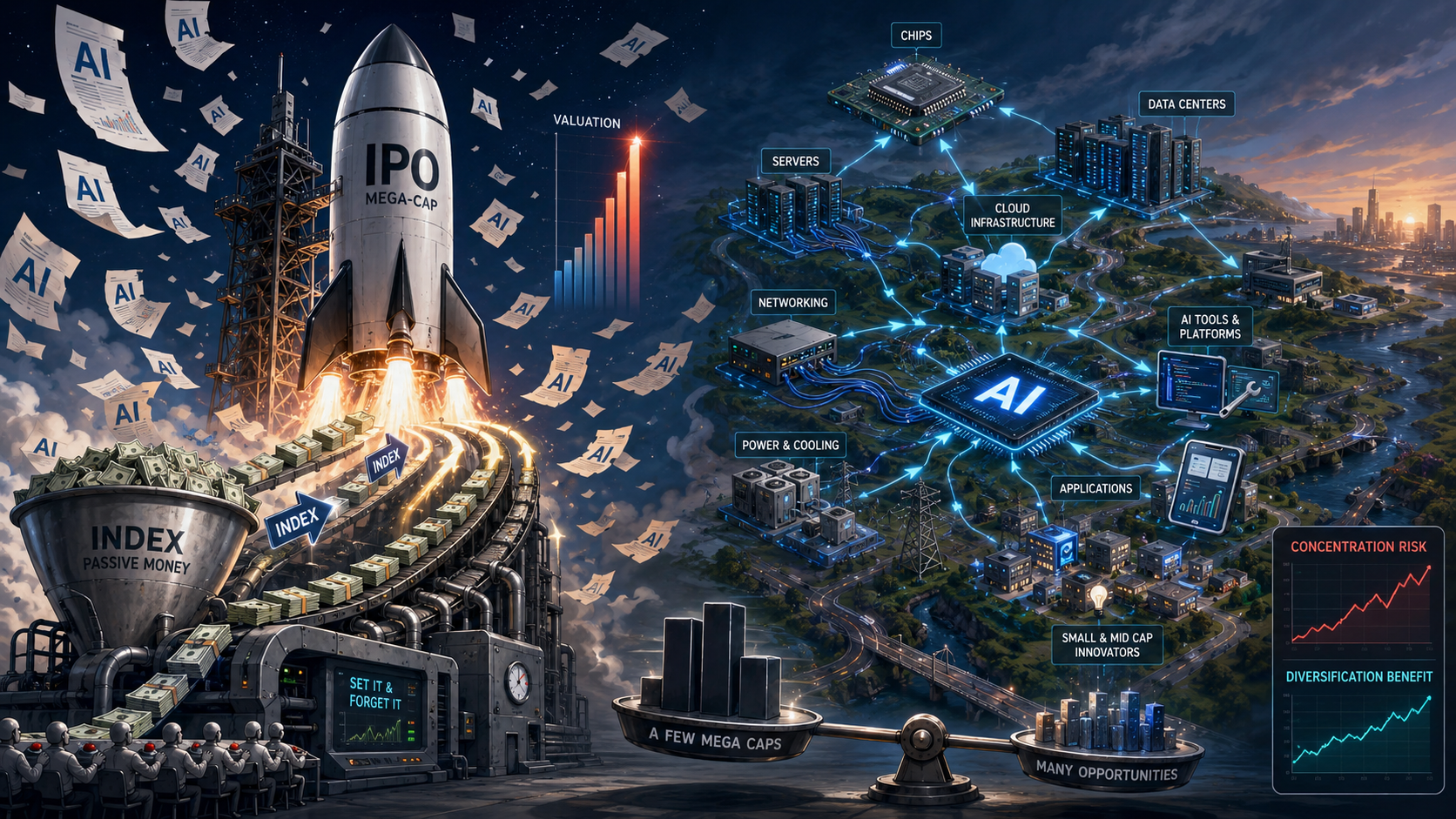
Here’s a stat that says everything about where the market’s head is at right now: in SpaceX’s IPO filing, the term “AI” reportedly shows up 1,251 times — more often than the word “Jesus” appears in the Bible. The observation comes from podcaster Ed Elson, and once you’ve heard it you can’t un-hear it. Welcome to mid-2026.
Frank Thelen’s fund shop TEQ Capital just dropped its June update, and instead of the usual “look how well we did” victory lap, it actually uses the SpaceX circus to make a sharper point about how today’s markets really work. Worth a read — so here’s the short, human version.
The biggest IPO ever (probably)
SpaceX is heading to the public markets at a targeted valuation of roughly $2 trillion. If that holds, it would be the largest IPO in history and would instantly make SpaceX the seventh most valuable company on Earth — ahead of Meta, Walmart, JPMorgan, even Tesla.
The catch is the math. As Elson pointed out, Google went public growing at triple-digit rates and priced at a fraction of the multiple SpaceX is now asking for. In other words: slower growth, much richer price tag. Rockets are cool. Valuations still have to land somewhere.
The part nobody’s talking about: the passive-money machine
This is where the TEQ piece gets genuinely interesting. Their senior advisor Gunnar Miller zeroes in on a quiet but important detail — the apparent waiving of Nasdaq’s “seasoning period,” the rule meant to stop passive investors from being shoved into freshly listed stocks at inflated prices.
Once a mega-cap like this gets added to the big indices, tens of billions in passive money flows in automatically — not because anyone decided the company is worth it, but because the index says so. High valuation pushes up the index weighting; the bigger weighting forces passive buying; the buying props up the valuation. Round and round it goes.
Miller’s line nails it: “Nasdaq didn’t sell SpaceX to the public. It sold the public to SpaceX.” That’s the kind of sentence you remember.
AI is real — it’s just bigger than seven stocks
None of this means the AI boom is fake. TEQ’s argument is the opposite: the technology is real and the productivity gains are coming. But precisely because it’s real, piling everyone’s money into the same handful of mega-caps is the risky move, not the safe one.
The actual value gets created across a much wider stack — chips, infrastructure, tooling, the unglamorous plumbing beneath the headline names. TEQ’s whole pitch is to invest along that full chain, deliberately including companies well beyond the “Magnificent Seven.” Their reasoning: tech revolutions rarely mint just one winner.
The scoreboard: back over €100M and an all-time high
So how’s that working out? By TEQ’s own numbers, pretty well. Since Mike Judith came on board in mid-July 2024 and the strategy was retooled:
- Disruptive Technologies (their all-cap fund): +78.1% over the past two years, after costs — comfortably ahead of the Nasdaq-100, per the firm.
- Small & Mid Cap Technologies: +42.0% over two years, recently hitting a fresh all-time high.
(All figures as reported by TEQ, in EUR after costs, as of 29 May 2026.)
Two more notable bits: roughly a third of the money in their public funds now comes from professional investors — a decent vote of confidence for a shop once dismissed as a “celebrity fund” — and total assets under management have climbed back above the €100 million mark.
And a new toy: the AI ETF
To put the “don’t bet on just seven stocks” thesis into practice, TEQ launched a General Artificial Intelligence ETF in early 2026. It tracks the tighter AI value chain across around 90 companies, aiming to give retail investors exposure to genuine AI names beyond the usual index heavyweights. Since launching in mid-January, it’s gathered about €14 million.
The takeaway
Strip away the fund-marketing gloss and there’s a real idea here: in a market where passive flows increasingly set prices and a single IPO can bend the rules of the exchange it lists on, concentration is quietly becoming the dangerous bet. Spreading out — even within a megatrend as hot as AI — starts to look less like caution and more like common sense.
Or, as the SpaceX filing accidentally reminded us: when everyone’s praying to the same three letters, it might be time to diversify your faith.
Based on TEQ Capital’s June 2026 investor update by CSO Mike Judith (wallstreet-online.de). Performance figures are TEQ’s own, as of 29 May 2026. This is a write-up, not investment advice — past returns don’t predict future ones, and fund values can fall as well as rise.
Leave a Reply