
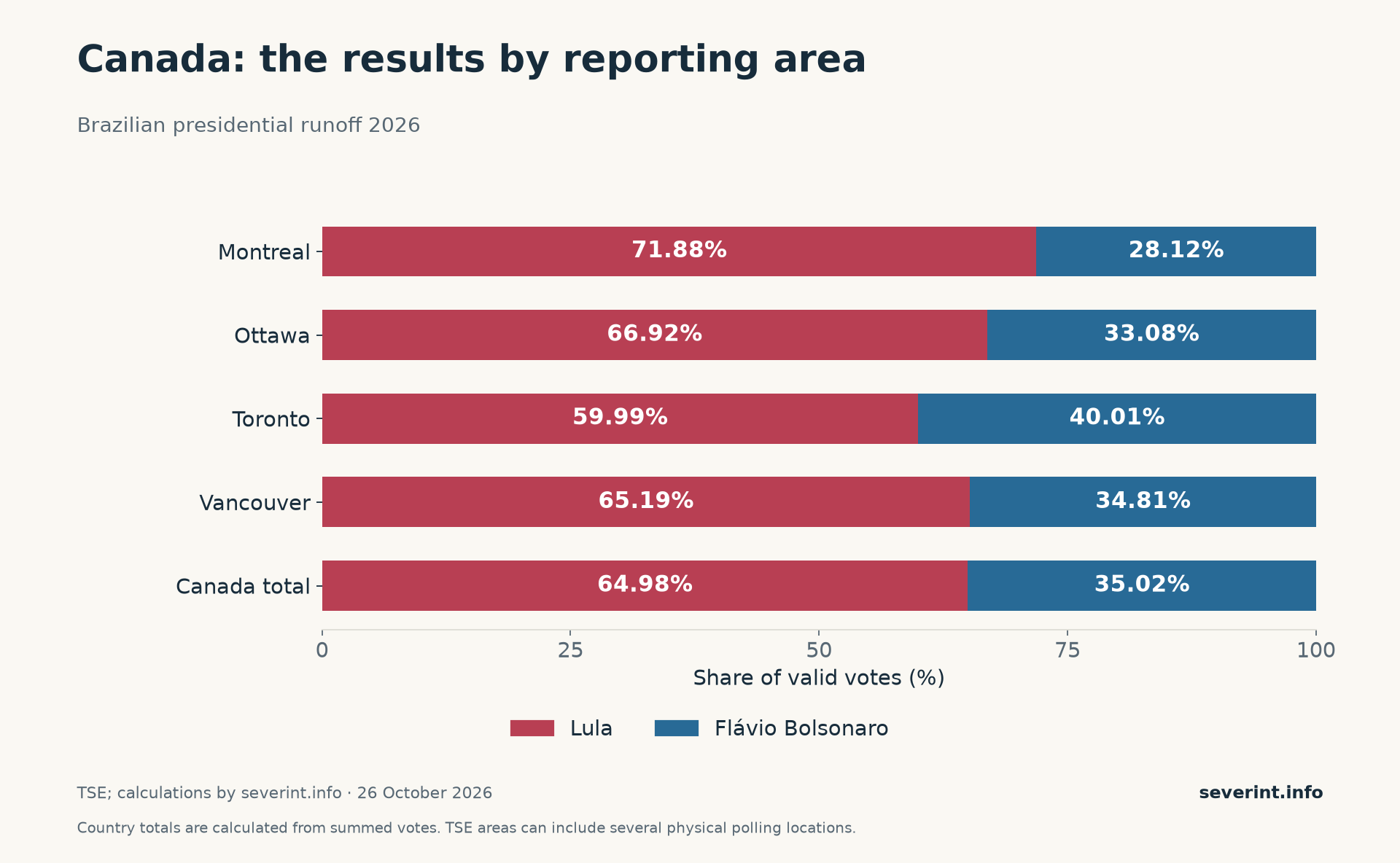
Lula won 64.98% of valid Brazilian presidential runoff votes in Canada and led in all four TSE reporting areas. Montreal gave him his highest share, while Toronto supplied the largest number of votes. Turnout rose to 54.01%, well above the overseas average.
Across Montreal, Ottawa, Toronto and Vancouver, Lula received 15,776 votes and Flávio Bolsonaro 8,501. Lula’s net lead was 7,275. That made Canada an important positive contribution to his overseas result, though overseas votes as a whole remained a small part of Brazil’s national count.
A win in all four areas, with clear differences
| TSE reporting area | Lula votes | Bolsonaro votes | Lula share | Turnout |
|---|---|---|---|---|
| Montreal | 4,747 | 1,857 | 71.88% | 61.99% |
| Ottawa | 961 | 475 | 66.92% | 64.05% |
| Toronto | 5,959 | 3,975 | 59.99% | 48.62% |
| Vancouver | 4,109 | 2,194 | 65.19% | 54.15% |
Montreal gave Lula 71.88% of valid votes, the highest share of the four. Ottawa followed at 66.92%, Vancouver at 65.19% and Toronto at 59.99%. Even the lowest of those shares was above Lula’s 53.86% across all overseas areas.
Toronto was the largest voting block, with 9,934 valid votes and 5,959 for Lula. But Montreal produced the larger net surplus: 2,890 votes, compared with Toronto’s 1,984. Vancouver contributed a Lula surplus of 1,915 and Ottawa 486. The four balances add up to the country lead of 7,275.
Ottawa had the highest turnout

Ottawa’s turnout was 64.05%, followed by Montreal at 61.99%, Vancouver at 54.15% and Toronto at 48.62%. Together, the four areas recorded 25,039 participants among 46,361 registered electors. Another 21,322 did not participate.
Of the ballots recorded, 24,277 were valid, 304 blank and 458 invalid. Turnout was 54.01%, compared with 41.63% across the overseas electorate. Canada was also above the UK’s 42.06% and the US rate of 32.98%. Those comparisons describe participation; they do not reveal its causes.
Lula’s advantage widened between rounds
| Measure | First round | Runoff |
|---|---|---|
| Lula votes | 12,508 | 15,776 |
| Flávio Bolsonaro votes | 7,043 | 8,501 |
| Other candidates | 2,107 | – |
| Valid votes | 21,658 | 24,277 |
| Participants | 22,446 | 25,039 |
| Turnout | 48.43% | 54.01% |
In the first round, Lula received 12,508 votes, or 57.75% of all valid votes. Bolsonaro received 7,043, or 32.52%. Other candidates received 2,107. Lula already led in each of the four Canadian reporting areas.
Between rounds, Lula added 3,268 votes and Bolsonaro 1,458. Lula’s margin expanded from 5,465 to 7,275. Participation increased by 2,593 people, while valid votes increased by 2,619 because blank and invalid votes together fell by 26.
The finalists’ combined gain of 4,726 votes is the sum of the 2,107 first-round votes for other candidates and the 2,619 additional valid votes. It does not prove that every supporter of an eliminated candidate moved to a particular finalist. People can enter or leave participation, and opposing movements can disappear in a net total.
Canada differed sharply from the United States
Lula’s Canadian share was 27.63 percentage points above his 37.35% in the United States. The US analysis shows how strongly results also differed within that country. Canada was much closer to the United Kingdom, where Lula received 63.34%.
These are Brazilian election results for participating electors, not measures of Canadian, American or British political opinion. Nor do the administrative area names mean that every vote came from the named city. The official directory includes Quebec City under Montreal, Winnipeg under Toronto and Calgary under Vancouver.
Data and method
We summed the four TSE overseas reporting areas Montreal (30155), Ottawa (30252), Toronto (30635) and Vancouver (39063), retaining each round’s own register and participation totals. Country shares are calculated from summed valid votes rather than mean area percentages. Reporting areas can include multiple polling locations. The data do not identify individual voter transfers or the preferences of every Brazilian resident in Canada.
Sources: TSE official results portal; Official runoff data; TSE overseas runoff total; First-round raw data; Official polling-location directory; Montreal runoff return; Ottawa runoff return; Toronto runoff return; Vancouver runoff return.
Data as of 26 October 2026. Calculations and graphics: severint.info. Presidential election only. Figures may not add exactly because of rounding.
Explore the Brazil election series
- Brazil election 2026: where Lula built his winning margin
- Poor for Lula, rich for Bolsonaro? What Brazil’s election data show
- Brazil election in Germany: 79.09% of valid votes went to Lula
- From trailing to winning: where Lula gained between Brazil’s two rounds
- Brazil’s non-voters: where turnout was lowest in the 2026 election
- Jair in 2022, Flávio in 2026: how Bolsonaro’s strongholds changed
- Brazil election 2026: ten numbers that explain the result
- Election fraud in Brazil in 2026? What the data from both rounds show
- Brazil election in Austria: 74.98% of valid votes for Lula
- Brazil election in Switzerland: Lula wins with 56.68%
- Brazil election 2026 abroad: how every country voted
- Brazil election in the UK: 63.34% for Lula, 42.06% turnout
- Brazil election in the US: Bolsonaro wins 62.65% amid sharp local divides
Leave a Reply