
Our checks found no arithmetic discrepancies in the published presidential results for either the first round or the runoff. Candidate votes, participation and territorial totals reconcile. That is a useful finding, but it is not proof that every aspect of the election was free of irregularities.
The question “Was there election fraud?” contains several different questions. Were the published totals added correctly? Do they accurately reflect the original polling records? Were voting machines functioning as intended? Were voters pressured or campaign rules broken? A check of published aggregate data can address the first question much more directly than the others.
What we checked in both rounds
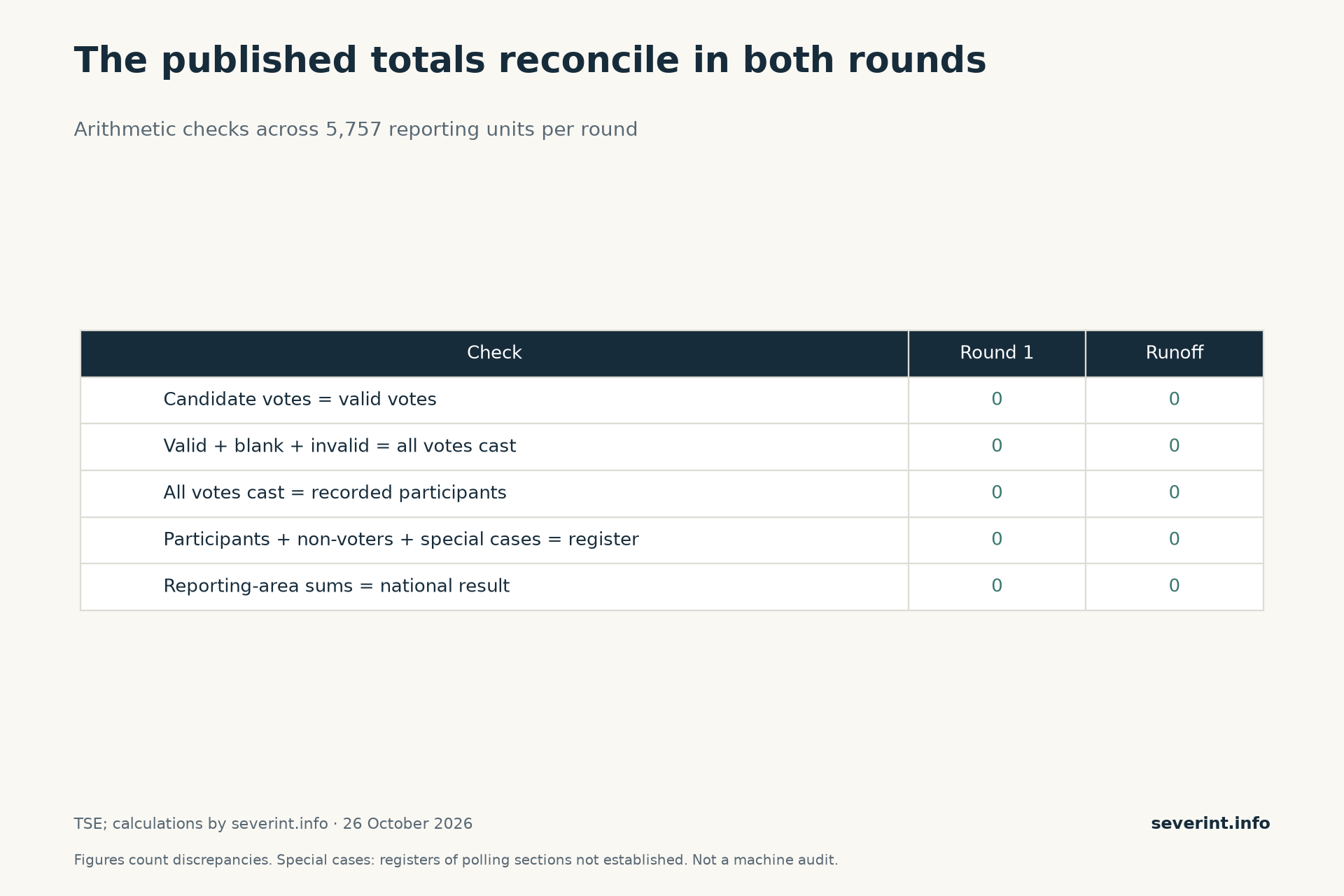
We tested the same 5,757 territorial reporting units in each round: 5,571 domestic municipal or equivalent units and 186 overseas areas. We checked whether candidate votes sum to valid votes; whether valid, blank and invalid votes sum to all votes cast; and whether the latter equals recorded participation.
We also reconciled participation, non-voting and entries in polling sections that were not established with the electoral register. Finally, we compared territorial sums with the official national returns and checked for negative values and turnout above 100%. For the runoff, we additionally reconciled all 28 state-level or overseas aggregate files.
First round: the published totals are internally consistent
For 4 October, the data record 119,300,788 valid votes, 2,300,798 blank votes and 3,674,249 invalid votes. Together, they equal the 125,275,835 recorded participants. Candidate totals and national aggregates also match. No domestic municipal reporting unit had turnout above 100%.
This does not mean there were no local electoral offences. The Federal Public Prosecutor’s Office in Alagoas described voting as generally normal while documenting incidents and suspected irregularities, including campaign-related cases and alleged unlawful voter transport. Such reports concern particular conduct and places; they do not by themselves demonstrate falsification of the national presidential count. Source: MPF on first-round incidents in Alagoas.
Runoff: the sums also reconcile
For 25 October, the published files contain 124,082,273 valid votes, 1,430,496 blank votes and 2,723,305 invalid votes. Their sum is 128,236,074 participants. Lula’s 64,256,232 votes and Bolsonaro’s 59,826,041 add exactly to the valid total.
A separate issue was the extension of voting. On election night, the TSE said that, under a Supreme Court decision, voting would continue only where it had not finished by 5pm. Reception, totalisation and publication of results would resume after 7pm. This official notice explains a pause in result publication; a national arithmetic check cannot determine whether individual procedures merit a complaint. Source: TSE clarification, 25 October.
What the documented controls show
According to the TSE, an integrity test at its headquarters entered 389 votes previously recorded on paper into two randomly selected machines and compared the results. No discrepancy was found. The same report says the first-round test at the TSE headquarters also produced no differences. These are concrete findings for those tests, not a complete examination of every machine used in the election. Source: TSE integrity-test report.
The Organization of American States sent 89 specialists and observers from 22 countries for the runoff and announced a subsequent preliminary report. Dispatching a mission is not itself a verdict on the election. Any assessment must be based on what its actual findings say. Source: OAS, 20 October.
An unusually high share does not prove fraud
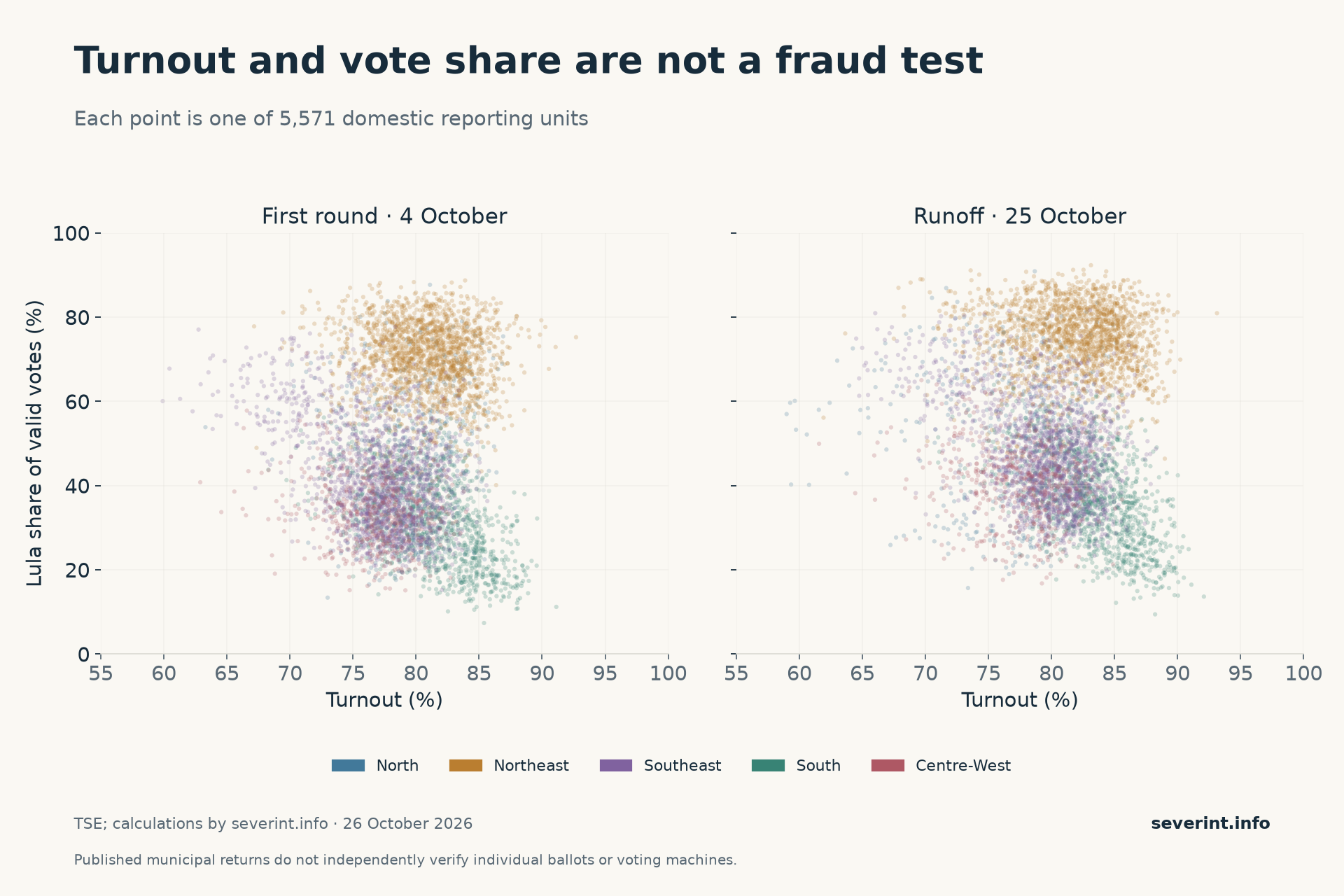
In the runoff, Lula exceeded 90% in eleven domestic municipal areas and Bolsonaro in one. Neither received 100% in any domestic unit. The highest municipal turnout was 93.12%; in round one it was 92.69%. These are descriptive figures, not established thresholds separating valid and suspicious elections.
Politically similar communities can produce one-sided results. A relationship between turnout and a candidate’s share may also have social or regional explanations. A manipulation allegation needs verifiable evidence, such as independently preserved polling records, conflicting original documents or reproducible technical findings. An exceptional percentage alone is not enough.
Two register details are not missing votes
The national files include 423 register entries from overseas polling sections that were not established. Adding only participants and non-voters and comparing that sum with every register entry would therefore create an apparent gap. Separately, the raw-data portal explains 39 duplicate register assignments arising from temporary voter transfers. That documented register correction is distinct from the 423 entries and does not mean that 39 double votes were proven.
The conclusion is limited, but clear
The published results examined here show no arithmetic sign of incorrectly added votes or participation exceeding the electoral register in either round. Because the underlying numbers come from the same official system, their agreement is not independent confirmation of every ballot. This analysis cannot comprehensively establish or rule out local offences, voter intimidation or technical manipulation.
The finding is that the published totals are consistent. Wider claims of election fraud require specific, checkable evidence. Our income comparison and regional analysis help explain why results can vary sharply without treating that variation as evidence of wrongdoing.
Data and method
We checked published presidential results at municipal or overseas reporting-area level. First-round candidate and detailed-count CSV files were aggregated across electoral zones, including separately recorded transit votes. Runoff figures come from the official result files. Checks cover five accounting relationships, negative values, turnout limits and national totals, plus state-level runoff reconciliations. We did not carry out a complete polling-record audit, inspect voting hardware or conduct nationwide fieldwork. External reports are attributed and described within their stated scope.
Sources: TSE official results portal; Official runoff data; First-round result; Raw data and register note.
English edition of our German-language analysis.
Data as of 26 October 2026. Calculations and graphics: severint.info. Presidential election only. Figures may not add exactly because of rounding.
Related fact check: Lula’s 10 million extra votes: checking the claims in an X post. Official totals, the São Paulo breakdown and the limits of claims about individual voter transfers.
Explore the Brazil election series
- Brazil election 2026: where Lula built his winning margin
- Poor for Lula, rich for Bolsonaro? What Brazil’s election data show
- Brazil election in Germany: 79.09% of valid votes went to Lula
- From trailing to winning: where Lula gained between Brazil’s two rounds
- Brazil’s non-voters: where turnout was lowest in the 2026 election
- Jair in 2022, Flávio in 2026: how Bolsonaro’s strongholds changed
- Brazil election 2026: ten numbers that explain the result
- Brazil election in Austria: 74.98% of valid votes for Lula
- Brazil election in Switzerland: Lula wins with 56.68%
- Brazil election 2026 abroad: how every country voted
- Brazil election in the UK: 63.34% for Lula, 42.06% turnout
- Brazil election in Canada: Lula wins 64.98% and leads in all four areas
- Brazil election in the US: Bolsonaro wins 62.65% amid sharp local divides
Leave a Reply